Roadblock

The Fifa world cup has only just finished. Unfortunately, neither Wales nor England came out victorious, although both gave a fairly good account of themselves.

My memories of the world cup go back to the final in 1966, the year England did manage to win. We were staying at my Nain’s house in Barmouth. I remember the final, but I did not see it. Instead, I was fascinated by the people on Barmouth High Street. Back in 1966, televisions were not as ubiquitous as they are today, so people who wanted to see a particular event had to find a friend or relative who owned a television and hope to be invited in. Gwynfor Owen owned the radio and television shop on Barmouth high street, two or three doors down from Nain’s. For the duration of the world cup, he put a television quite high up in the shop window so that passers-by could see live pictures from the matches. From the first-floor window we had a good view of people as they passed by.

Classic photo of England team after world cup victory

For the final, quite a crowd had gathered. So many that they spilled onto the road, which was narrow and one-way. As the match progressed and became more exciting, the crowd got larger and less inclined to move along. In the end the traffic came to a complete standstill. As Barmouth High Street is the only road along the coastal route the queue must have stretched for miles. When the final whistle was blown, and England had won there were celebrations in the street. I guess that it took a while for the traffic flow to return to normal.

Another time the High Street was closed was when my mum took her piano home to Port Sunlight from Barmouth. The piano, which was a self-playing pianola, was in the parlour on the first floor. Since the piano was installed, the house had been altered so that it was no longer possible to carry it down the staircase. Instead, it was taken out through the first-floor window, which, in turn required removing the window frame.  All in all, this was quite a palaver. Getting the piano through the window needed a front loader and several removal men. Of course, the street was blocked with traffic being redirected by the police. The event made the national newspaper, the Cambrian times.

In January 2014, a severe storm damaged the railway line and parts of the coastal defences near Barmouth. As a result, a couple of stranded trains had to be transported by road from the coastal stretch to safety in Chester. The most difficult part of the journey was getting the train past Nain’s house. This was well documented by the BBC.

Train being transported through Barmouth. Nain’s house (Glanaig) on left

I think that Nain could have told us many stories about the things that could be seen from her first-floor window. She and Taid had the perfect place in the centre of the small town. Their home was constantly visited by people from all over the place and all were made welcome.

Nain = Grandmother, Taid = Grandfather in Welsh.

Just as an afterthought, my latest scan showed no undesired activity in or around the operation site, so I am good to go for another three months.
Two years

Today marks two years since a glioblastoma was discovered inside my head. Since then, I have had one operation, radiation therapy, electric field treatment, cytostatics and loads of different tests and scans. After all of that, I am still here and feeling healthy.

The results of the latest MR-scan will be here soon. Then we will open some bubbly.

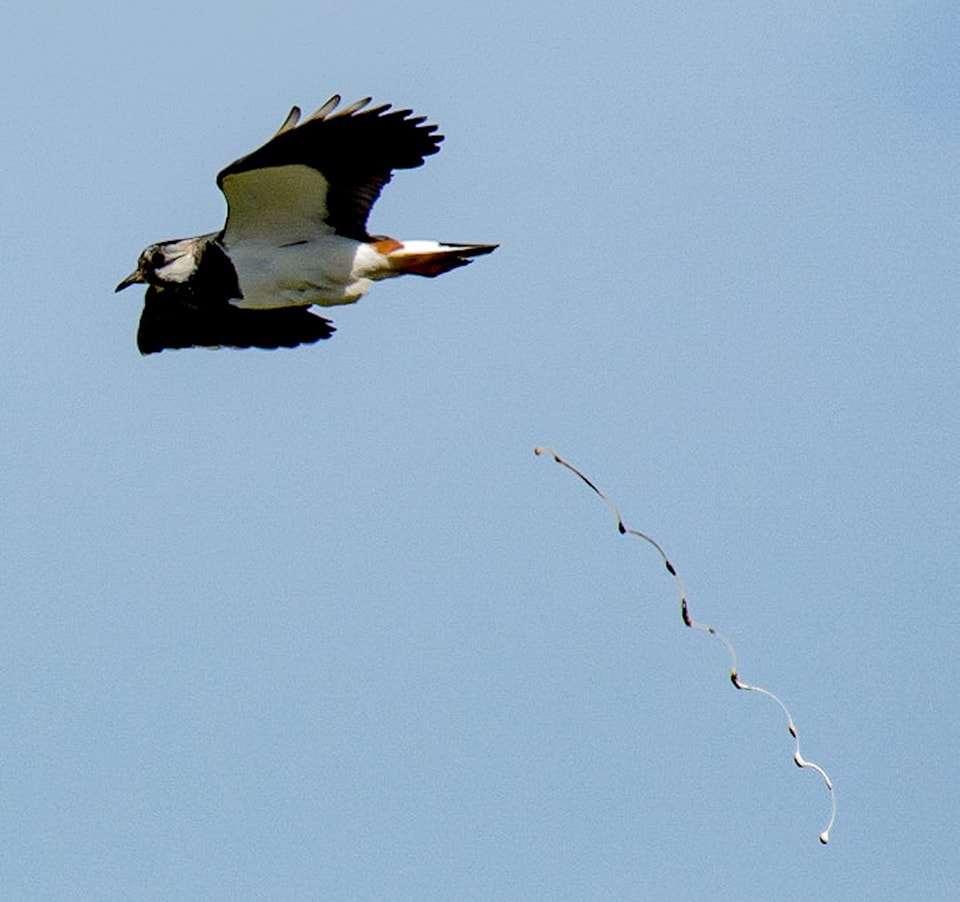
This lapwing (Tofsvipa in Swedish) Vanellus vanellus, sums up my feelings towards cancer.

Tick the box

Spring and summer, for me, means getting out into the countryside. Either for long walks, bike rides or a round of golf. Churchill once described golf as an effective way to ruin a good walk. The way I have been playing lately, I tend to agree.

Being out in the countryside also means being exposed to the perils and deadly threat of wildlife such as ticks.

In my opinion, ticks serve no useful purpose in the greater scheme of things and therefore, if they disappeared, they would not be missed. As vectors for Lyme disease (also known as borrelia) and tick-borne encephalitis, TBE, ticks do pose a serious threat to our health and wellbeing. I therefore, took the opportunity to get vaccinated against TBE, when out shopping a couple of weeks ago.

My dislike of ticks started when I was a child and used to go on walks in the hills behind my grandparents’ house in Barmouth. I don’t recall ever being bitten by a tick, but the fear of them has been ever-present ever since.

Proof of TBE-vaccination

A number of years ago, I was on a ride in the countryside when a call of nature required me to take a discrete stop by the roadside. Much relieved, I continued my ride, but after a short while, I noticed something moving just above my knee. It was a tick, I quickly brushed it away and continued, but I started getting an itchy feeling, the sort that can turn up just at the mention of tiny creature that try to nourish themselves on my blood. Slightly irritated, I stopped just to check, and found another trying to creep under my cycle-shorts. Fearing the presence of more unwelcome passengers, I turned off the road onto a deserted logging trail and found a large boulder on which to stand. Sure enough, I found another tick preparing itself for a few microlitres of my precious blood. Just to be sure that I had no more ticks, I removed my jersey and shook it thoroughly in the hope that I would be rid of any more ticks. As the logging trail was deserted, I did the same with my shorts [in order to avoid chaffing, cyclists have nothing between their shorts end skin]. Just as I stood clothed as I was born, waving my shorts in the air, an elderly lady rode sedately by. “Watch out for the ticks!” I called, but received no reply.

So, if you are out in the countryside, watch out for ticks ….. and cyclists!

All quiet on the western Front.

I just took a look at the read-statistics for my blog for the last couple of weeks. On average the site receives a visit every third, which is quite good considering that it has been neglected for some time. Almost half a year has passed since my last entry.

For the past six months, I have been at work on a 50 % basis. Some time in the office and some time working from home. I have found working again to be inspiring, but at the same time very tiring. Fatigue is one of the main symptoms of treated glioblastoma and the accompanying treatment, and I can assure you that it needs to be taken seriously. I am now looking forwards to a long summer break to recharge for more activities in the autumn.

The last couple of weeks have been a bit stressful. I was at the hospital for an MR-scan, a routine that I must go through every three months. Waiting for the results is unpleasant as for every day that passes, the worry that all is not well grows. I could at last read the results of the scan this afternoon. They could not have been better. No change in status since the last scan and no signs of cell-growth in the operated area. What a great relief that was. I was also at the ophthalmology department today for a series of tests of peripheral vision. Even these tests returned positive results. So, all in all, things are looking good for the future.

This afternoon, I spent a few hours with colleagues from Mistra at the Stockholm Museum of photography, Fotografiska, to see an Andy Warhol exhibition and a load of other fantastic works of photographic art. We followed this with a glass of wine before returning to our homes. Very soon the holidays will begin.

For copyright reasons I cannot publish any of the works on display at the museum. Here is my interpretation of one of the photographs!

Man in checkered shirt (Photo Bitte)

Knitting, a pastime for all

Knitting has become very popular in recent times, and while I cannot claim to be a pioneer, I can trace my knitting roots back to about 1966 (The same year England won the world cup in football).

My mum was an avid knitter and would regularly produce loads of items as an opportunity presented itself. Items would include pullovers, cardigans baby-clothes, gloves, mittens, hats, and a variety of items that sold well at the annual church festival. Not only did Mum hand-knit, she also used a tabletop knitting machine.

This machine took a while to set up, with a number of hooks and levers. Adjustment of said hooks and levers determined the type of stitches leading to the creation fantastic patterns. The knitting machine, once set up, was easily worked by pushing the handpiece back and forth to create row after row of knitted fabric.

On one particular occasion, the machine was set up to knit the sleeve of a pullover, with a new ball of wool loaded and ready to go. Mum was busy getting dinner ready, and I could not resist the chance to show my creative skills. I pushed the handpiece back and forth again and again. As I did, the sleeve grew and grew until the entire ball of wool was consumed. I was very pleased with myself having produced a magnificent, perfectly straight pullover sleeve about 3 metres in length. We were not a happy family that evening!