Fire in the hole

Warning: Kleenex recommended

Five years ago, we were just beginning to understand the severity of the COVID-19 pandemic and the necessity to isolate as much as possible from each other.

At the same time, I was admitted to hospital with what turned out to be a brain tumour.

We realised straight away that the diagnosis was very serious and that the outcome would not be good.

I started this blog as a way to remind myself of all the good times and of all the funny things that have happened to me during my lifetime. This was a diversion for me to stay focused on things that are more precious to me.

What resulted is a series of anecdotes and commentaries on the way things are, were, or could have been. Judging from the response, I think that some of my writings have been a bit interesting.

 Your comments and encouragement have been very much appreciated throughout this time.

This is the entry that I knew would have to come one day and that I have dreaded. It is with a very heavy heart that I write these next lines.

A few weeks ago, I went for a routine checkup at the MR- lab. The images showed that the cancer had returned to approximately the same place at the back of my brain. There was a slight hope that it would be possible to operate although this would involve considerable risk to my field of vision. My team were doubtful from the start.

A new set of images has shown that the tumour has continued to grow at such a rate that it will not be possible to operate. A consequence of previous treatments with chemotherapy is that the tumour is almost certain to be resistant, meaning that further treatment is not an option.

For the journey that I have ahead of me, I have my own resistance, resilience and wicked sense of humour together with support of my family and you to take me as far along the road as possible.

We are devastated by this development, while at the same time determined to make every moment count. In the meantime, I feel strong and healthy and able to meet the challenges ahead. It may be difficult, but I find strength and encouragement in your support.

We have rekindled our collection for the Swedish brain foundation hoping your generosity will allow us to reach a new target, see an upcoming blogpost.

Keep yourselves posted on this blog as I may yet find some anecdotal pearls of wisdom somewhere in the bottomless pit of my memories.

Our door is almost always open, so if you are passing by you will certainly be welcome to drop in for a tea or coffee. Call on our mobiles first, and just in case bring a bun or similar so you won’t have to leave hungry!

Still enjoying the countryside near Gamla Uppsala

Staying alive

It’s now gone three months since my latest operation. The surgery went very well although it was a bit bigger than I had expected. Since then I have had three rounds of chemotherapy, which have resulted in me being very tired and fatigued. I took the last tablets of my third round yesterday evening and am now looking forward to a couple of weeks of recovery over the Christmas break.

After the festivities, I have another three rounds of chemotherapy, after which, I should be back on track again. I have also an MRI booked in the beginning of January to check that I still have a hole in my head and no activity.

I’ve not been good at writing anything on my bloglately, but I really appreciate all the comments that have turned up in the meantime and I feel that your support always gives me some extra energy.

As we move into the Christmas season, I, together with the rest of my family, send you our best wishes for the holiday period and for the year to come.

I´ll be back.

Post-op update!

Chris opererades idag och är nu på NIMA (neurokirurgens intermediäravdelning). Han är vid gott mod men trött och har ont i huvudet vilket inte är så konstigt. Jag har pratat med honom och hoppas få besöka honom imorgon om han då har fått flytta till en vanlig avdelning. Jag har också pratat med läkaren som opererade och han var nöjd med operationen.
Chris hälsar!

Vid tangentbordet: Bitte

Keep yer knickers on!

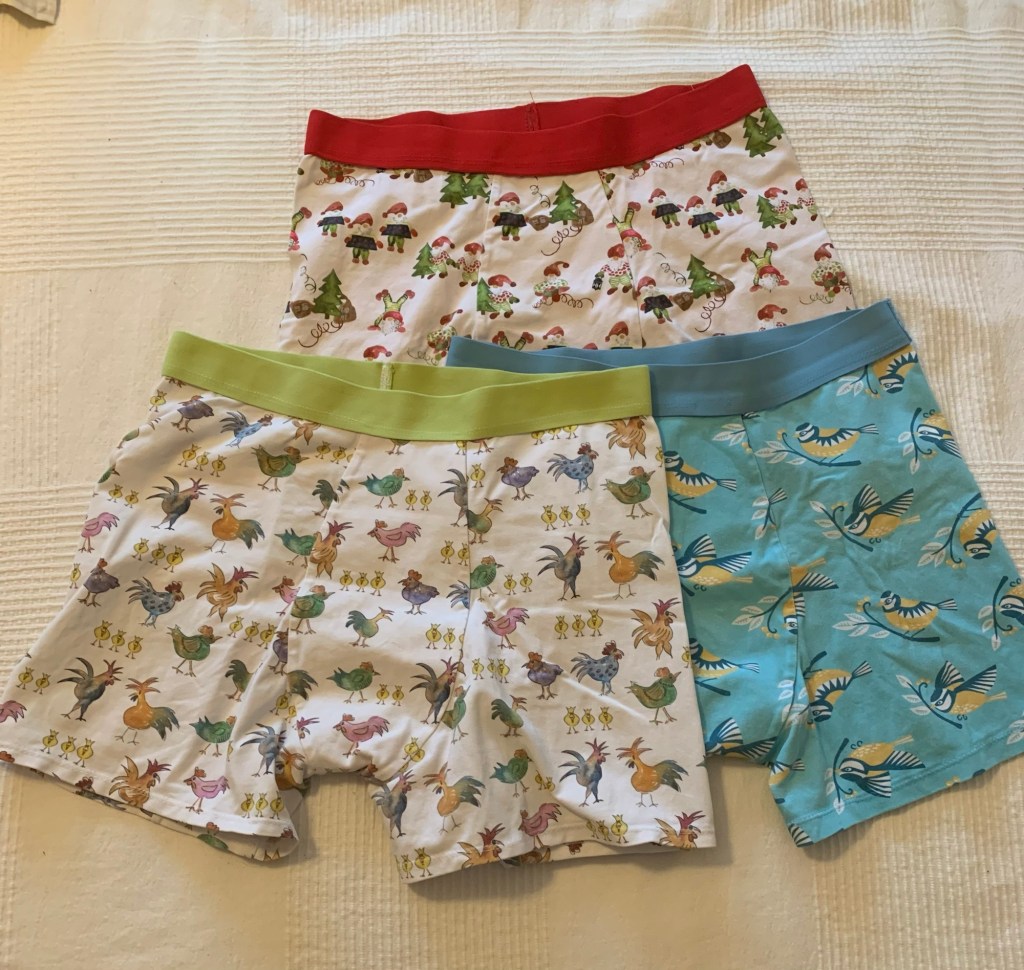
The phrase “keep your knickers on” is idiomatic slang meaning stay calm and composed, or do not get flustered. Changing “your” for “yer” turns the phrase into the vernacular, in this case scouse, where knickers can even refer to underpants. As I wrote earlier, 12 November 2020, keeping knickers on in the Swedish healthcare system is not always as trivial as it ought to be. Next week, I will be testing the system again. I am booked for surgery on Tuesday, 10 September, to remove what appears to be a new tumour developing next to the site of the first one. Hopefully, the outcome will be as positive as it was four years ago. In the meantime, I will do my best to keep track of my underwear, and will post updates as the situation develops.

Home sewn underwear by Bitte

I have confidence in me!

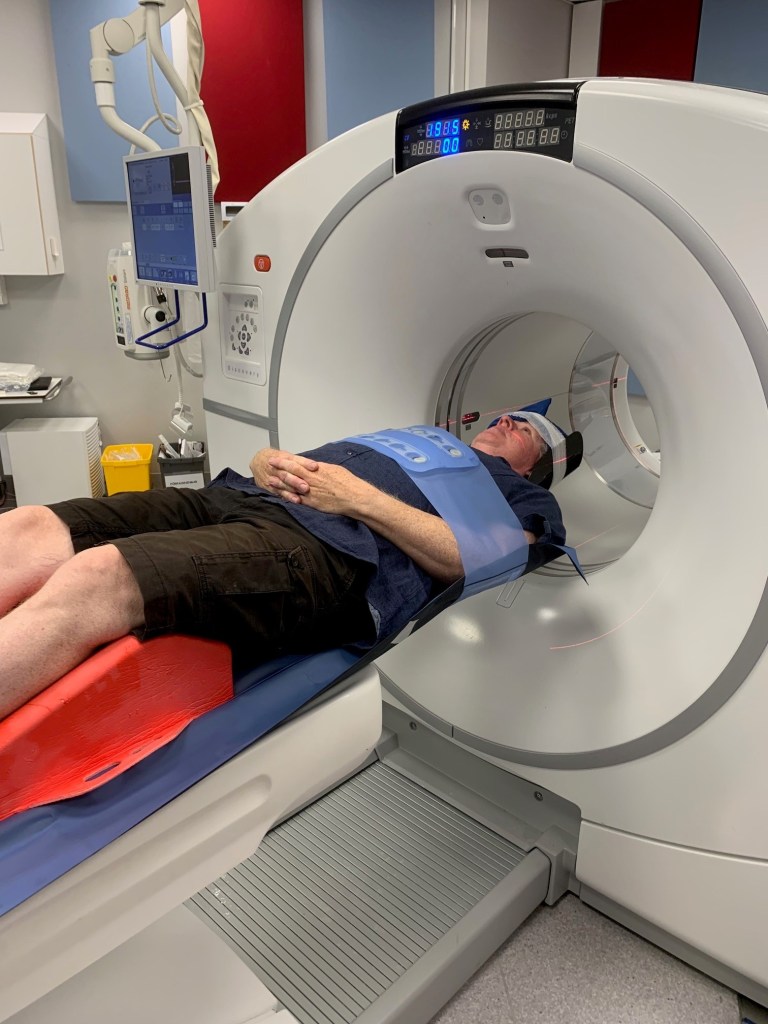
A while ago, I went to the radiology department at the university hospital for my quarterly MRT scan. The procedure is fairly standard. I arrived early and identified myself, using my driver’s license, to the assistant, who recognised me from previous visits but had to follow protocol. I was fitted with a tube into one of the veins in my arm for the contrast agent. The agent used is a gadolinium III salt. I have asked for information about which salt is used, but not received a satisfactory answer. Again, following protocol is the most important part of the treatment. For the scan, I was strapped onto a board, had my head securely fixed in place and inserted into the scanner. An MR-scanner makes a lot of noise, so I was equipped with ear plugs and a set of headphones. I chose to listen to the Beatles – a good choice as suggesting most of the music that I normally listen to results in perplexed expressions from the personnel operating the scanner. The scan went well resulting in good quality pictures. Patients are not permitted to see their scans until an expert has had the chance to examine and interpret them.

A week or so later, I checked my medical journal to see that everything was normal, normal being “The patient has a hole in his head and shows no signs of activity”. This time, the notes stated that there were signs of activity in the vicinity of the aforementioned hole. I was a bit worried (understatement) about this and called to my contact nurse at the oncology department and suggested further investigation with a PET-scan using isotope labelled methionine. The medical team agreed, and I was at the PET-centre a few days later. This scan confirmed that there was some activity present, and my case was, therefore, presented at a meeting attended by the leading experts at the hospital. The consensus at the meeting that the observed changes were small but significant and should be followed up after a few weeks to see how things develop.

The few weeks have now passed and the follow up showed that the area with activity has developed to such a degree that surgery is probably necessary to remove as much of the developing tumour as possible, preferably as soon as possible. The course of action is a PET-scan tomorrow using C-11 labelled methionine to map the extent of the tumour then surgery sometime soon, hopefully next week.

Given the options available: surgery possibly followed by chemotherapy, only chemotherapy, i.e. no surgery or no action at all, I think that opting for surgery is a foregone conclusion. One might say “a no-brainer! (pun intended).

The wait for decisions and action is a bit worrisome, but I have been through this before, and I have confidence in the medical team and my own strength to get through it, and above all, the support of those around me.

We will update the blog as things develop. In the meantime, I have already started work on new posts for the future.

Home

Today was the 6th of June. It was a lovely sunny slightly windy day. We stayed at home and relaxed for most of the time. In the afternoon our daughter and her family, including husband and our two lovely grandchildren came to visit. We had a BBQ, enjoyed the jacuzzi and relaxed.

Swedish national day

The 6th of June is a bank holiday in Sweden. This is because it’s the national day. Most shops are closed, and people generally stay at home or meet friends and chill. The 6th of June is also the day when I defended my PhD thesis way back in 1986. That particular day was very interesting, not just because of my PhD thesis but also because of the party we had in the evening and the events that happened there.

My faculty opponent didn’t find much to question about my thesis at least not the content instead he decided to complain a lot about the language. Him being Norwegian and me being British meant that he didn’t have a lot to come with, so the discussion was quite short. After the afternoon’s deliberations, the committee awarded me a pass, leaving everybody happy so that we could go on to the party later in the evening.

My parents had travelled over from Port Sunlight to see the culmination of my “Studies on nucleoside and nucleotide chemistry”, and like most people present, they did not understand much of what was said, but appreciated my achievement.

Academically, the highlight of a post-graduate education is passing the formal defence of the thesis, but in the real world, the highlight is the party held afterwards. At the time, the defendant, me in this case, was expected to finance the party and to provide a suitable bar (it’s called “groggbänk” in Swedish). In preparation for the party, I had persuaded a friend, who commuted on a weekly basis to Finland, to supply me with a steady flow of duty-free booze. By the time of the party, my “groggbänk” was well stocked, as became apparent during the evening (Some, but not too much, artistic license is applied in the remainder of this entry, as the result of hearsay, and more or less vivid reconstructions after the fact).

My opponent, the Norwegian guy, took a liking to my mother, inviting her up to dance several times, which my supervisor proceeded to point out to my father. His response was that she was a big girl and could look after herself. Thereafter he offered said supervisor a whisky from the bar (at my expense, I might add).

All went well during the party, with live music, lots of dancing and general merriment. Some time, close to midnight, somebody pointed out that our new post-doc seemed to be a bit tired. This being the case, we ordered a taxi to take him home. The taxi promptly arrived, and our post-doc was positioned in the passenger seat while we waved goodbye and went back to the party. A few minutes later, I was tapped on the shoulder and found the taxi driver needing my attention. He explained that he had a slight problem in deciphering where our post-doc lived. I followed, along with a few other people out to the taxi to find a happy post-doc in the passenger seat. The taxi driver asked him “Where do you want to go?”

“HOME” was the answer, or rather hoooome! As he was new to the lab nobody was quite sure exactly where he lived. In the end somebody fetched my supervisor, who was still at the bar with my dad, and we got the whole thing sorted out.

Shortly afterwards, I found my dad drinking whisky with my opponent while my supervisor sat talking to my mum. We, Bitte and I, danced away the rest of the night and, as the sun came up above the horizon we went “hooome.” 😊

Twelfth night

Today is the twelfth day of Christmas (as known from the song) and marks the end of the Christmas festive period in the UK, in Sweden we continue until January 13th. In the days of my youth in the UK, we took down our Christmas decorations the day after, Epiphany. Old tradition suggests that the general rules accepted by society are thrown out of the window on twelfth night, allowing for wild parties and strange happenings, this is the theme for the Shakespearian romantic comedy “Twelfth night” which includes scenes of partying, cross dressing, mistaken identity and much more. The day after, Epiphany or the thirteenth day of Christmas, celebrates the revealing of the newborn child as the messiah. It also marks the arrival of the three wise men from the orient with gifts of gold, frankincense, and Myrrh. These were useful gifts; gold, naturally as raising children is an expensive undertaking. Frankincense and myrrh are both perfumes, which would have been useful as this was long before the advent (sic) of modern nappies.

On their way to Bethlehem, the three wise men were not so wise, and alerted king Herod about the arrival of a potential rival resulting in a purge of baby boys and our biblical hero having to take a detour through Egypt on the way home. This story contains a few incongruities, the census initiated by Quirinius took place in the year 6 AD, much later than the famed birth. King Herod, who was reportedly upset by the birth of a potential rival, died in the year 4 BC. The reference could have been to Herod Antipas, who was born sometime between 20 BC and 6 BC. However we look at it, we should not let a few factual discrepancies ruin a good story.

The reason why I brought this subject up is that there is a Christmas song based on the travels of the three wise men.

By Mario Lanza (who incidentally played Caruso in the film “The great Caruso”, and was a hero of my dad), but written by John Henry Hopkins in 1857 and made famous by The Beach Boys in 1964 – some more incongruities.

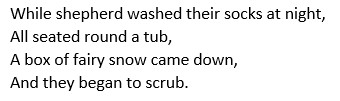
As children getting into the raucous spirit of twelfth night, we used to sing alternative lyrics to many of the songs. For this particular song our alternative was:

Another favourite was to change:

Into:

At the Christmas carol service of 1970 at Christ Church, Port Sunlight, both of the above songs were included in the programme. Being very enthusiastic, I sang both loud and clear the alternative versions. After the service, the vicar complemented me on my fine voice, but gave me a good telling off for my choice of lyrics. I think he was quite amused but had to be stern in order to maintain his authority.

Christ Church Port Sunlight

With this, I wish you all a happy and prosperous 2024.

A visit to accident and emergency

WARNING: The following article contains violence and may be disturbing. Parental guidance is advised.

Please note that this article concerns a “normal” visit to A&E with no connection to my brain tumour. The tumour has not shown any signs of activity and can be considered well under control.

I woke up the other day with a peculiar feeling at the top of my leg, in the groin area. A careful inspection by touch – a visual was not possible as the 63-year-old body I occupy is not as supple as it once ought to have been – confirmed my suspicions that a boil or abscess was developing. I made a mental note to keep the situation under control. During the day that followed, the thing grew to what felt like the size of a tennis ball, but was in reality, a little over 1 cm.

The pandemic taught us about cleanliness which was applied in this case. By the evening things had deteriorated to such an extent that I called the health care services for advice and was told to visit A&E if things didn’t improve. By the next morning the boil had ruptured, releasing some unpleasant stuff which I will not go into any more detail about. As a result, I greatly sympathise with the residents of Reykjanes in the south-west of Iceland.

Molten rock oozes from the ruptured earth at Reykjanes

I packed a book, a computer, and a few other essentials for an expected long day in the waiting room and made my way to the hospital. I quickly manoeuvred my way past the gatekeeper nurse using my considerable descriptive powers together with a degree of exaggeration and arrived at the waiting room where I happily spent the next six hours reading, snoozing, exchanging messages, and reprimanding myself for not bringing any food or drink.

At last, it was my turn. The doctor quickly concluded that my visit to A&E was the correct course of action and that boil needed to be opened up and drained, which she said would be a source of pain and discomfort. I was offered the alternatives of morphine or xylocaine of which I chose the latter – “A good choice” she announced in the manner of a waiter in one of the better restaurants after a guest chooses one of the not so cheap wines on the menu.

Once I was suitably prepared, assistance was called for and a nurse promptly appeared. The scene was set: certain parts of my anatomy were wrapped in a blanket and being pulled in one direction while my leg was being pushed in the other. The doctor held a razor-sharp scalpel ready to slice into the unpleasantry on display (this is a reference to the boil and nothing else!) The procedure was over fairly quickly, and while uncomfortable was relatively painless. The workings of the human mind are a bit strange, during this episode I observed that the nurse had biceps that put my meagre offerings to shame. I made a mental note to myself that I am due to spend more time at the gym.

I am now under instructions to keep the wound clean and dressed, and while somewhat bruised in the nether region, I will recover in time to hang some coloured baubles in the Christmas tree.

Merry Christmas everybody.

Second best

Back in 1973, a brass band was formed, on the initiative of Ralph Peters, in my village, Port Sunlight. I joined the band in early 1974, to play the baritone. Although I had played the bugle, I had no experience of playing a brass instrument with valves. I could read music, having played the recorder and clarinet earlier, but like most of the players in the band, I was a complete novice. Some of the players, including my brother, David, and trumpet/cornet player Bobby Thelwell were already very good and helped the rest of us along.

Band practice took place on Sunday and Wednesday evenings at the Boys’ Brigade club house in the Lyceum. The band’s name was taken from the building; thus, Lyceum Brass was born.

https://lyceumbrassband.wixsite.com/home

In the early days our band master was Wilf, a retired worker from the soap factory with a passion for brass bands, and a passion for cigarettes. Wilf liked to try out all the instruments whenever possible, so we quickly learned to always remove the mouthpiece whenever leaving the instrument, avoiding the smell and taste of consumed tobacco. In our post covid world, the idea of borrowing someone else’s instrument seems out of the question.

Our early practices concentrated on the red book of hymns for brass bands, with “Cwm Ronddha” and “Ar hyd y nos” as particular favourites.

After a few years, our level of playing improved, likewise our repertoire. Competitions are a part of the brass band culture, both in the UK and internationally. By 1978, we believed ourselves to be ready to enter our first competition in order to qualify for the lowest section of the national and regional brass band league system. Our first competition was in Belle Vue, Manchester. My memory of the occasion may have become a bit hazy for various reasons, but the general course of events was as follows: The competition involved playing a test piece of music for a jury, who were not allowed to see the band performing nor to know which band it was. The piece we had to play was, for us, technically challenging. We practiced for weeks and became quite good at playing it, although by the time we got to the competition, we were a bit sick of it.

As I recall, there was one other band competing for a single place in the section. We were a couple of players short for the performance, so I had to play a combination of first and second baritone, hoping that the judges would not notice. (I believe that there was a comment that the balance between baritone 1 and 2 was good).

While waiting for the results, we all found different ways to amuse ourselves. One of the bass players consumed a few beers then took a ride on the big dipper (Belle Vue had an amusement park) and was somewhat pale by the time the results were presented! The master of ceremonies made the announcement that we had place second in the competition. This caused the other band to celebrate rather enthusiastically until the news that they came third was announced. The judges deemed Lyceum brass to have given the better performance but thought that we needed more time to reach the required standard.

I left the band later that year, as I went of to London to study at university. The band progressed and will celebrate 50 years this year.

All this goes to show that second best is not such a bad thing.

I still play the euphonium and the recorder, although I am no longer at the level I was at in 1978.

The results of my latest scan were really good (no second best here). Everything looked good with no sign of unwelcome visitors inside my head.

Enjoy the summer!

The Bells

With the approaching coronation of Charles III, there is apparently a need for more bellringers throughout the UK. This was highlighted by Swedish television the other day.

https://www.svt.se/kultur/brist-pa-klockringare-infor-kung-charles-kroning

When I still lived in Port Sunlight, I learnt a little bellringing myself under the direction of John Hulse and together with some friends from the, now disbanded, Boys’ Brigade. While it looks simple, the ringing is quite complicated. Ringing in a group requires having full control over the bell, which weighed in at between 180 and 650 kg. The sequence followed specific patterns called out by the bell master. The patterns followed a simple set of rules which I used to write a computer programme to work out all the possible permutations. Nobody was ever interested in my programme, so I did not develop It further.

Practice was on Mondays with Services twice on Sundays and the occasional wedding on Saturdays. For funerals a single bell was rung, usually with a leather glove on the clapper to muffle the sound.

For weddings, we would ring the bells about five minutes prior to the arrival of the bride. If she was late, it could be quite tiring. When the bride arrived, we stopped the ringing and either sat quietly in the ringing room or snook out to the pub for a quick drink (underage!). If the weather was good, we would sit on the roof of the bell tower behind the ramparts and wait for the signal to ring the bells as the newlyweds left the church. On one occasion, one of the ringers was a bit bored, so he decided to walk around the top of the ramparts, with a drop of 20 m to one side. When we got the signal, we went back inside and rang the bells as for every other wedding. As the bride and groom were leaving through the main entrance, they were greeted by the fire brigade, who had been called by some neighbours worried by the people running around the roof. With the ringing completed, we crept out from the back of the church. We got a good telling off the next day!