A visit to accident and emergency

WARNING: The following article contains violence and may be disturbing. Parental guidance is advised.

Please note that this article concerns a “normal” visit to A&E with no connection to my brain tumour. The tumour has not shown any signs of activity and can be considered well under control.

I woke up the other day with a peculiar feeling at the top of my leg, in the groin area. A careful inspection by touch – a visual was not possible as the 63-year-old body I occupy is not as supple as it once ought to have been – confirmed my suspicions that a boil or abscess was developing. I made a mental note to keep the situation under control. During the day that followed, the thing grew to what felt like the size of a tennis ball, but was in reality, a little over 1 cm.

The pandemic taught us about cleanliness which was applied in this case. By the evening things had deteriorated to such an extent that I called the health care services for advice and was told to visit A&E if things didn’t improve. By the next morning the boil had ruptured, releasing some unpleasant stuff which I will not go into any more detail about. As a result, I greatly sympathise with the residents of Reykjanes in the south-west of Iceland.

Molten rock oozes from the ruptured earth at Reykjanes

I packed a book, a computer, and a few other essentials for an expected long day in the waiting room and made my way to the hospital. I quickly manoeuvred my way past the gatekeeper nurse using my considerable descriptive powers together with a degree of exaggeration and arrived at the waiting room where I happily spent the next six hours reading, snoozing, exchanging messages, and reprimanding myself for not bringing any food or drink.

At last, it was my turn. The doctor quickly concluded that my visit to A&E was the correct course of action and that boil needed to be opened up and drained, which she said would be a source of pain and discomfort. I was offered the alternatives of morphine or xylocaine of which I chose the latter – “A good choice” she announced in the manner of a waiter in one of the better restaurants after a guest chooses one of the not so cheap wines on the menu.

Once I was suitably prepared, assistance was called for and a nurse promptly appeared. The scene was set: certain parts of my anatomy were wrapped in a blanket and being pulled in one direction while my leg was being pushed in the other. The doctor held a razor-sharp scalpel ready to slice into the unpleasantry on display (this is a reference to the boil and nothing else!) The procedure was over fairly quickly, and while uncomfortable was relatively painless. The workings of the human mind are a bit strange, during this episode I observed that the nurse had biceps that put my meagre offerings to shame. I made a mental note to myself that I am due to spend more time at the gym.

I am now under instructions to keep the wound clean and dressed, and while somewhat bruised in the nether region, I will recover in time to hang some coloured baubles in the Christmas tree.

Merry Christmas everybody.

Second best

Back in 1973, a brass band was formed, on the initiative of Ralph Peters, in my village, Port Sunlight. I joined the band in early 1974, to play the baritone. Although I had played the bugle, I had no experience of playing a brass instrument with valves. I could read music, having played the recorder and clarinet earlier, but like most of the players in the band, I was a complete novice. Some of the players, including my brother, David, and trumpet/cornet player Bobby Thelwell were already very good and helped the rest of us along.

Band practice took place on Sunday and Wednesday evenings at the Boys’ Brigade club house in the Lyceum. The band’s name was taken from the building; thus, Lyceum Brass was born.

https://lyceumbrassband.wixsite.com/home

In the early days our band master was Wilf, a retired worker from the soap factory with a passion for brass bands, and a passion for cigarettes. Wilf liked to try out all the instruments whenever possible, so we quickly learned to always remove the mouthpiece whenever leaving the instrument, avoiding the smell and taste of consumed tobacco. In our post covid world, the idea of borrowing someone else’s instrument seems out of the question.

Our early practices concentrated on the red book of hymns for brass bands, with “Cwm Ronddha” and “Ar hyd y nos” as particular favourites.

After a few years, our level of playing improved, likewise our repertoire. Competitions are a part of the brass band culture, both in the UK and internationally. By 1978, we believed ourselves to be ready to enter our first competition in order to qualify for the lowest section of the national and regional brass band league system. Our first competition was in Belle Vue, Manchester. My memory of the occasion may have become a bit hazy for various reasons, but the general course of events was as follows: The competition involved playing a test piece of music for a jury, who were not allowed to see the band performing nor to know which band it was. The piece we had to play was, for us, technically challenging. We practiced for weeks and became quite good at playing it, although by the time we got to the competition, we were a bit sick of it.

As I recall, there was one other band competing for a single place in the section. We were a couple of players short for the performance, so I had to play a combination of first and second baritone, hoping that the judges would not notice. (I believe that there was a comment that the balance between baritone 1 and 2 was good).

While waiting for the results, we all found different ways to amuse ourselves. One of the bass players consumed a few beers then took a ride on the big dipper (Belle Vue had an amusement park) and was somewhat pale by the time the results were presented! The master of ceremonies made the announcement that we had place second in the competition. This caused the other band to celebrate rather enthusiastically until the news that they came third was announced. The judges deemed Lyceum brass to have given the better performance but thought that we needed more time to reach the required standard.

I left the band later that year, as I went of to London to study at university. The band progressed and will celebrate 50 years this year.

All this goes to show that second best is not such a bad thing.

I still play the euphonium and the recorder, although I am no longer at the level I was at in 1978.

The results of my latest scan were really good (no second best here). Everything looked good with no sign of unwelcome visitors inside my head.

Enjoy the summer!

The Bells

With the approaching coronation of Charles III, there is apparently a need for more bellringers throughout the UK. This was highlighted by Swedish television the other day.

https://www.svt.se/kultur/brist-pa-klockringare-infor-kung-charles-kroning

When I still lived in Port Sunlight, I learnt a little bellringing myself under the direction of John Hulse and together with some friends from the, now disbanded, Boys’ Brigade. While it looks simple, the ringing is quite complicated. Ringing in a group requires having full control over the bell, which weighed in at between 180 and 650 kg. The sequence followed specific patterns called out by the bell master. The patterns followed a simple set of rules which I used to write a computer programme to work out all the possible permutations. Nobody was ever interested in my programme, so I did not develop It further.

Practice was on Mondays with Services twice on Sundays and the occasional wedding on Saturdays. For funerals a single bell was rung, usually with a leather glove on the clapper to muffle the sound.

For weddings, we would ring the bells about five minutes prior to the arrival of the bride. If she was late, it could be quite tiring. When the bride arrived, we stopped the ringing and either sat quietly in the ringing room or snook out to the pub for a quick drink (underage!). If the weather was good, we would sit on the roof of the bell tower behind the ramparts and wait for the signal to ring the bells as the newlyweds left the church. On one occasion, one of the ringers was a bit bored, so he decided to walk around the top of the ramparts, with a drop of 20 m to one side. When we got the signal, we went back inside and rang the bells as for every other wedding. As the bride and groom were leaving through the main entrance, they were greeted by the fire brigade, who had been called by some neighbours worried by the people running around the roof. With the ringing completed, we crept out from the back of the church. We got a good telling off the next day!

All the time in the world

Back in 1969, the James Bond film “On her majesty’s secret service” was released, with George Lazenby in the title roll and Diana Rigg as leading actress. The film caused a stir because it was the first without Sean Connery as Bond.

For me, the film is most memorable for the song “We have all the time in the world” performed by Louis Armstrong. I wrote an arrangement of this song for Sixten Lakes giant sextet recently. The Giant sextet consists of seven to nine players, while my arrangement was for five players. Just like in Pirates of the Caribbean, these numbers should be seen more as guidelines.

The title of the song alludes to not having to hurry things as life is seemingly endless. My diagnosis from September 2020 initially changed this for me, giving a sudden feeling of urgency. Since then, I have undergone surgery, various rounds of cytostatics and radiotherapy, plus alternating electric field therapy, all of which have helped me reach where I am today.

This week, I got the results of my latest MR-scan. The images show that there are no signs of activity from the cancer cells and that the area surrounding the operation site looks completely healthy. Receiving this news is fantastic and allows me once more to say: “We have all the time in the world”.

Enjoy the music.

The pram

When I was about 6 or 7 years old, we lived in a house on the outskirts of Port Sunlight village, 156 New Chester Road to be exact. To the rear of the house were a set of garden allotments, which were a great playground for children of my age. We got up to all sorts of mischief, which generally resulted in a telling off by one or more of the gardeners.

On one particular day, my younger brother Williams’ pram was parked at the back of the house while he was indoors for his afternoon sleep. I thought that he would not mind if I borrowed the pram for a while. With a few friends we decided to see how many could ride in the pram at the same time. I think that we got seven or eight in the pram or hanging on to the outside. Of course, for this to count as any kind of record the pram must move a certain distance, so I pushed the pram a couple of yards. As the road was slightly inclined, I quickly lost control. In a state of panic, I pulled the brake, which resulted in the pram stopping immediately. It was at this instant that the practicalities of Newtonian mechanics became apparent to me, i.e., a body in motion will continue unchanged unless a force is applied to cause a change. The result was that while the pram stopped, my friends inside spilled out of the front into a heap on the road. Fortunately, there were no broken bones, but there were a number of cuts and bruises, and I had to explain to my mum how the pram got so scratched.

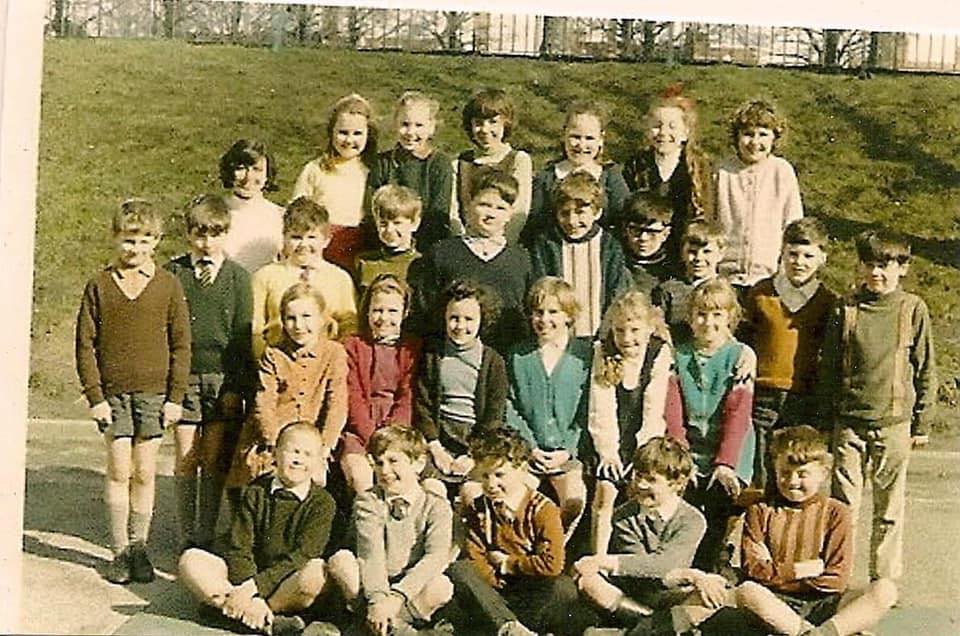
The next day, at school, the headmaster asked what had happened as a large portion of the front row in assembly ware either plasters or bandages. There were even a couple of black eyes. I don’t have a photo from the actual event, but this grainy picture shows my class a couple of years later. Maybe somebody remembers.

Church Drive Junior School. Class of 1969-70